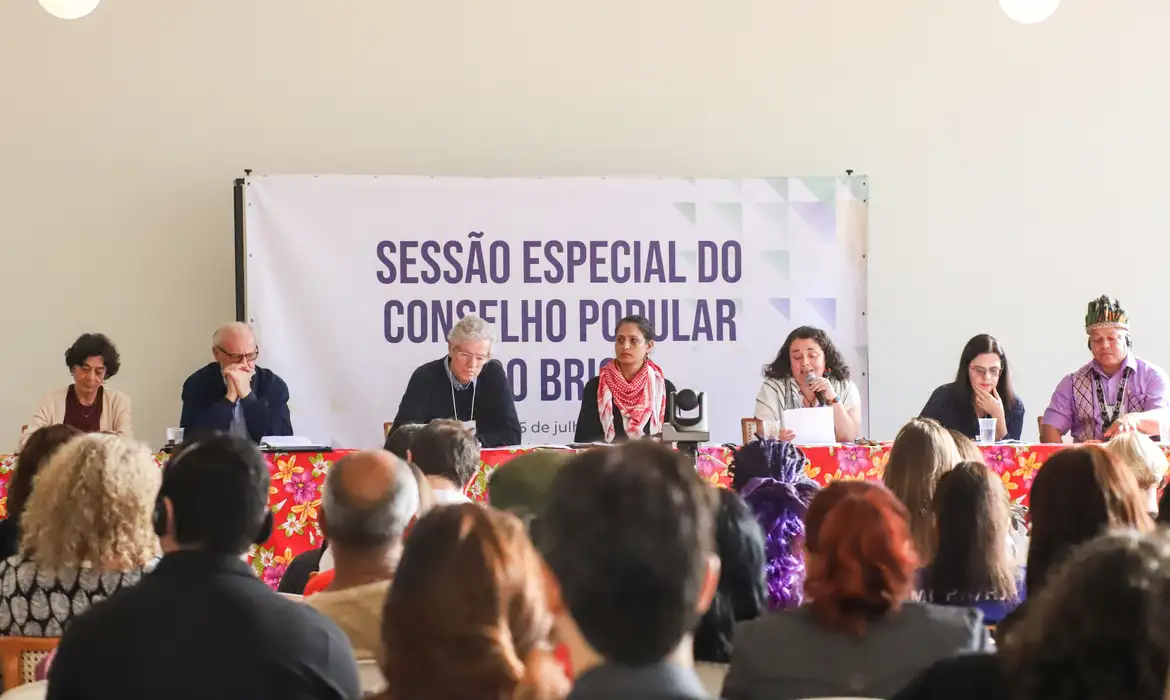
Document from the Popular Council suggests expansion, without citing Venezuela.
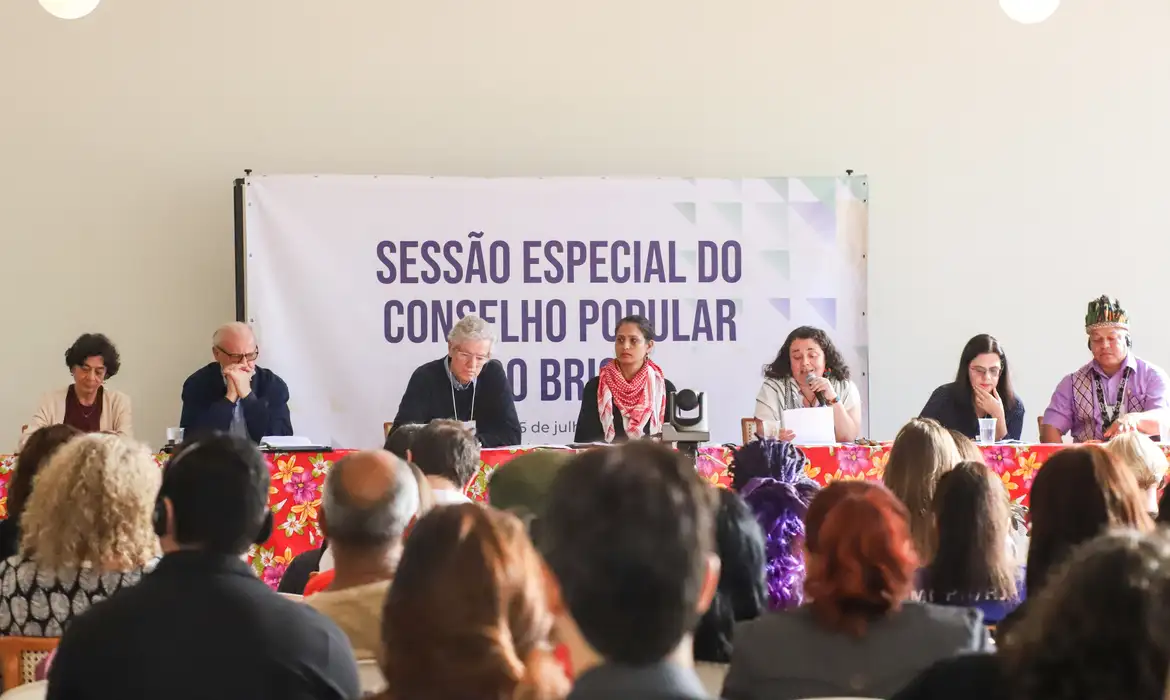 BRASÍLIA - 05/07/2025 - POPULAR COUNCIL.
Photo: Priscila Ramos
BRASÍLIA - 05/07/2025 - POPULAR COUNCIL.
Photo: Priscila Ramos
Venezuelan social movements formalized today (5) a request to participate in the Brics and the Popular Council of the bloc, formed by social organizations from member countries. The request was formalized through a letter delivered to the council itself, during the first meeting of the organization, in Rio de Janeiro.
Venezuela's entry into the Brics was rejected in 2024, at the summit meeting in Russia, which also recognized the Popular Council as part of the institution. The rejection of Venezuela, at the time, generated tension between Brasília and Caracas.
The request for participation was delivered by Venezuelan deputy Blanca Eekhout who is also president of the Simón Bolívar Institute of Friendship with the Peoples.
"As this council is precisely the Popular Council of the Brics, it is the desire of the Venezuelan popular movements to participate," said Blanca. She explained that the letter delivered to the council is the expression of the will of social movements, such as women's movements, community councils and indigenous peoples. "The Brics is a new, multipolar, pluricentric world, to which Venezuela has been committed from the beginning," she added to the Agência Brasil.
Alongside her, the representative of the United Indigenous Movement of Venezuela (MIUVEN), Cesar Carias, presented the request for Venezuela to enter the Brics "We thank you for the invitation to be here [at the council event], but, at the same time, with much respect, we request that the veto imposed on our country be removed and that our voice not be silenced," she claimed.
"The indigenous peoples and social movements of Venezuela want to be included in the Brics. This is our request to this council," added the leader, asking for support.
Last year, Brazil justified the veto on Venezuela's entry into the Brics by arguing a lack of transparency in the presidential elections in the neighboring country. On the other hand, Russia and China supported the political ally in South America and, in the assessment of experts heard by Agência Brasil, the country's adhesion to the bloc is only a matter of time.
Supporting Venezuela, but without expressly citing the country, the final document of the Popular Council, which will be presented to the bloc's summit on Sunday (6), will call for the expansion of full Brics members in Latin America. Today, there is only Brazil. Cuba and Bolivia are considered partners. Argentina, invited in 2024, under the presidency of Javier Milei, refused to join.
Global South
In the view of João Pedro Stédile, representative of the Landless Workers' Movement (MST) and the Alba Movimentos, which brings together around 400 organizations in 25 countries, Brazil's veto of Venezuela was a surprise. "As a position of the entire council, our position is to propose to the summit the maximum expansion of the number of countries. Right here, in Latin America, President [Luiz Inácio] Lula [da Silva] has already invited Colombia, invited Mexico, invited Uruguay, invited Chile. So, it makes no sense to exclude Venezuela, there is no reason," he declared.
The economist and coordinator of the MST has defended that, to gain strength, the Brics needs to grow in the Global South.
"For us, it is not enough just Venezuela, it is necessary to include the largest possible number of countries in Latin America, Africa, Asia, in short, the Global South, because the more countries we have from the Brics, the more strength the Brics will have to oppose the current crisis of imperialism and the United States," he concluded.
One of the main proposals of the bloc founded by Brazil, Russia, India and China is an alternative system that does not use the dollar as a reference currency in global negotiations
The Brics Popular Council was created and recognized in the Kazan Declaration in 2024. From this initiative, councils were formed in the member countries, with the intention of fostering the participation of civil society in strategic agendas. In Brazil, the construction of the popular council involved social movements, unions, NGOs and researchers.